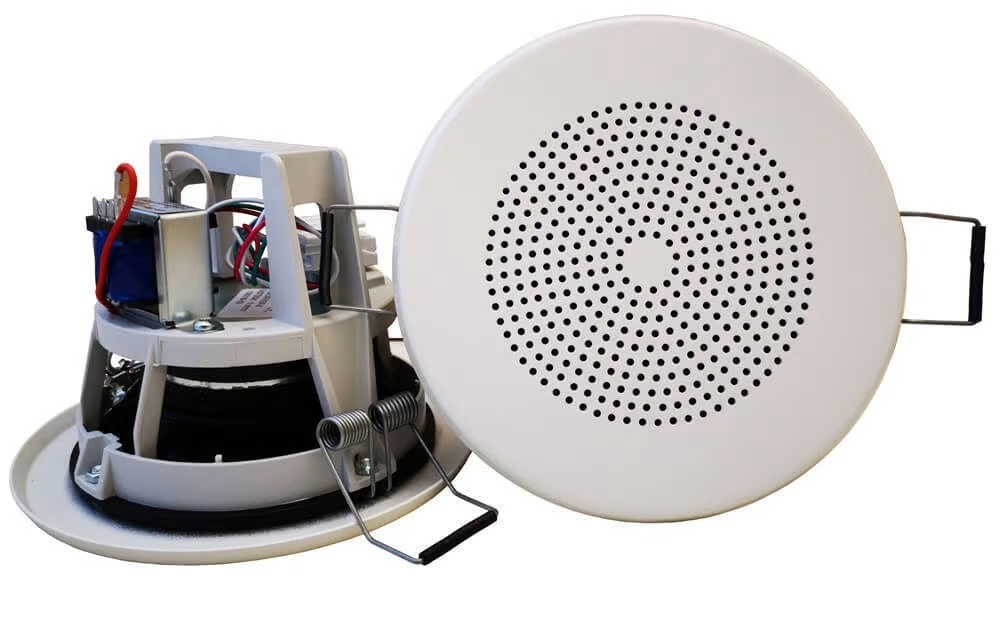
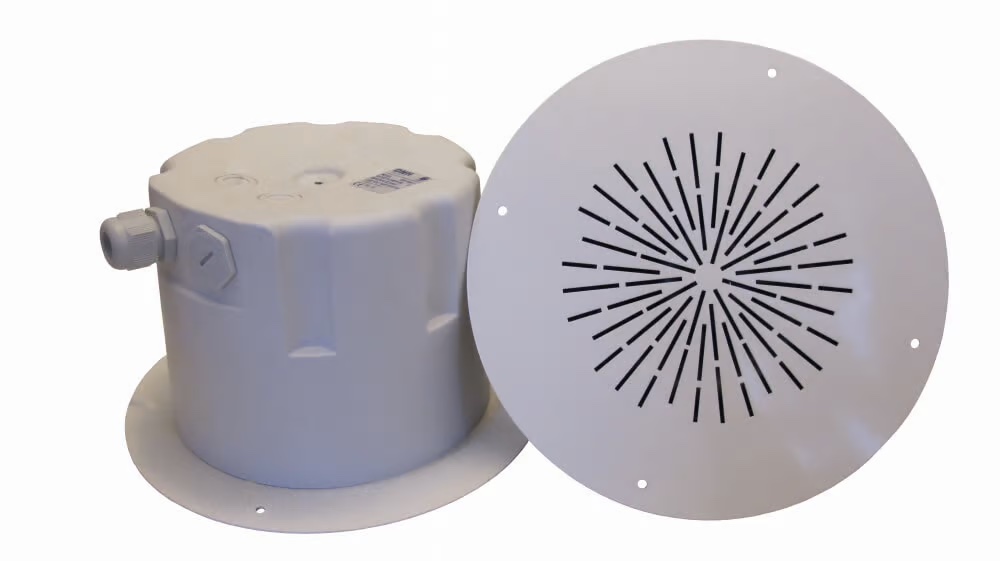
One noise reading. Every speaker adjusted to match.
A large site rarely has uniform noise levels throughout. A railway platform, a factory floor, or a multi-zone building can have dramatically different ambient noise in different areas, and at different times of day. Distributed Automatic Volume Control (DAVC) solves this properly: rather than tuning each output device in isolation, it lets your Public Address system respond intelligently to noise measured across the site as a whole.
How it works
DAVC uses a combination of inputs, an “AVC Source”, to measure ambient noise and calculate the correct output volume for an output device, or “AVC Receiver”. The AVC Source is typically a purpose-built EINS-1 Noise Sensing Microphone, but any Turbine device with a microphone, including intercoms, can serve this role. Measurements are sent to the AVC Receiver, typically a PA amplifier, which adjusts its loudspeaker output accordingly.
Because DAVC can draw on more than one input source, it can calculate a maximum, minimum, or average volume across an entire building, train station, or factory, rather than reacting to a single, potentially unrepresentative measurement point.
Built for genuinely demanding environments
The EINS-1 noise sensor is specifically designed for harsh, outdoor, and industrial deployments, including railway platforms, tunnels, and oil platforms, environments where ambient noise is both significant and highly variable. Its rugged, IP-65-rated housing withstands heat, cold, rain, and wind, so the sensor performs reliably in the conditions where accurate noise measurement matters most.
Flexible source and receiver relationships
DAVC supports both Local AVC, where a single device adjusts its own output based on its own microphone, and Remote AVC, where one device’s measurement controls another device’s output entirely. Multiple noise sensors can also feed into a single zone for increased accuracy, and a single sensor can, in turn, control multiple output devices, giving you real flexibility in how a site’s audio zones are structured and managed.
Simplify your system where it makes sense
You can even use only the intercom as the DAVC source, eliminating an entire subsystem of dedicated noise-sensing devices where a simpler deployment is more appropriate for the site. Because DAVC devices support remote maintenance and configuration over SNMP, your team can manage and adjust the system without physically visiting every input and output point.
Why it matters for your site
- Consistent audibility across large or multi-zone sites, not just at a single measurement point.
- Flexible deployment, using dedicated noise sensors, existing intercoms, or a combination of both.
- Built for harsh environments, with sensor hardware rated for genuinely demanding outdoor conditions.
- Simplified system design, with the option to eliminate a separate noise-sensing subsystem entirely.
- Remotely manageable, reducing the need for on-site visits to maintain or adjust the system.
Talk to STENTOFON Communications Australia
If your site has varying noise levels across different zones or times of day, our specialists can help you design a Distributed Automatic Volume Control configuration that keeps your PA system intelligible everywhere it needs to be.